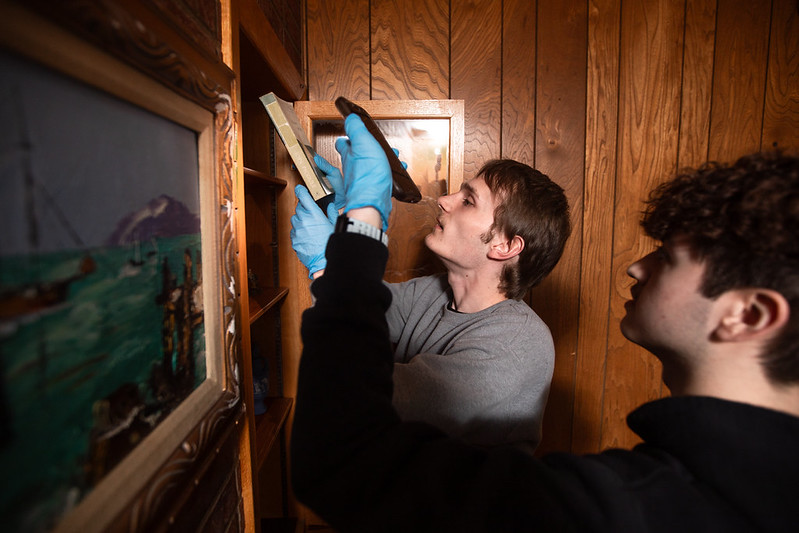
On Wilson Avenue in Clarion sits a non-descript house. Neither the outside nor the inside hints at the investigative training – the searches for drugs and weapons and the collection of evidence – that takes place behind its ordinary front door.
The house is PennWest Clarion’s crime house, a small, two-bedroom space where criminal justice students can put their classroom learning into practice. While the crimes are simulated and the drugs and weapons are fake, the experience offers something invaluable: a realistic, hands-on understanding of investigative work. The house has become a key educational resource not only for PennWest students, but also for local high school programs preparing students for careers in law enforcement.
“Classrooms are great, and they definitely have their place, but it’s one thing to learn from someone telling you about a search, and it’s quite another for you to conduct the search yourself,” said Dr. Jennifer Boyer, associate professor of criminal justice. ”I can talk about a grid search versus a spiral search, but when students actually do it themselves, they get a lot more out of it.”
Since its establishment in 2019, the crime house has primarily been used to teach search techniques and proper documentation. PennWest students benefit from this immersive experience, applying theory in a setting that mirrors real-life investigations. At the same time, the house serves as an important bridge for high school students, giving them early exposure to college-level expectations and career pathways in criminal justice.
That connection was on display April 29, when seniors from the Clarion County Career Center’s three-year police science program visited campus. The visit allowed students to step into a college learning environment and apply skills they’ve been developing in their own classrooms, reinforcing the crime house’s role as a shared resource that supports both secondary and postsecondary education.
Before beginning their search, students completed a key step in the investigative process: filling out a search warrant application detailing what they were looking for. Prior to their arrival, Boyer and their instructor, Chris Richardson, had hidden fake guns, drugs, cash and diamonds throughout the house.
“Be meticulous. Search every square inch,” Boyer advised.
Using the zone technique assigned by Richardson, students divided each room into directional quadrants. Donning gloves, they carefully began their search, working methodically through each space.
Boyer, who holds both a juris doctor degree and a Ph.D. and previously worked as an assistant public defender, emphasized the importance of documentation – an area she considers her specialty.
“Before you touch the item, you need to document – take a picture of it with the context of where it was found, take a wide shot, then zoom in on the item; keep track of who found it,” she said. “Having documentation is important in getting a conviction.”
For high school students, opportunities like this can be transformative, offering a preview of both college coursework and professional expectations. For PennWest students, the crime house continues to provide a realistic training ground that strengthens their readiness for careers in criminal justice.
Together, these experiences highlight the crime house as more than just a learning space. It is a valuable, hands-on resource that supports students at multiple stages of their educational journey.
The high school program prepares students to enter the workforce or continue their education at the college level. For more information about PennWest’s criminal justice program, visit https://www.pennwest.edu/academics/programs/criminal-justice/index.php.