Amber McKay
From “Why do you act like that?” to the science behind it
A senior psychology major at PennWest Edinboro, Amber pairs lab research on attention
and neurotransmitters with peer leadership to turn “why” into compassionate, evidence-based
“what happened to you?”
Amber McKay
From “Why do you act like that?” to the science behind it
A senior psychology major at PennWest Edinboro, Amber pairs lab research on attention and neurotransmitters with peer leadership to turn “why” into compassionate, evidence-based “what happened to you?”
"I like to see how these neurotransmitters actually make us act and how they can... help our attention and hurt our attention."
The question lived in Amber McKay’s head for years: Why do you act like that? She arrived at college with “no interest in psych whatsoever,” enrolled in Intro to Psychology, and everything clicked. Today, Amber is a senior Psychology major at PennWest Edinboro—the question didn’t vanish; it evolved. “I learned to move from why do you act like that? to what happened to you?—what’s going on in your brain and body?”
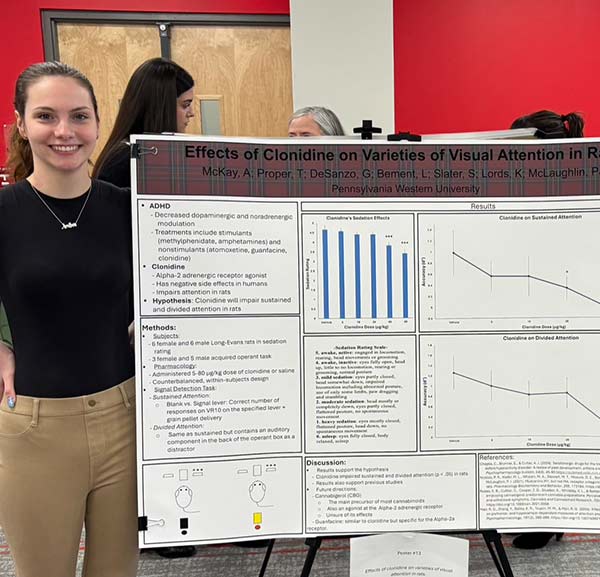
At PennWest Edinboro, Amber leaned into the science. In Dr. Peter McLaughlin’s behavioral pharmacology lab, she studies attention and neurotransmitters—hands-on research that turns textbook concepts into data. “We’re working with rats to see how neurotransmitters help or hurt attention,” she explains. The lab culture, she says, is an old-school apprenticeship: read, design, test, refine. The payoff is confidence and clarity about a career in the mind-brain space.
Her work hasn’t stayed in the notebook—she’s presented findings at regional undergraduate conferences and translated methods sections into real‑world skills: data collection, analysis, and scientific writing.
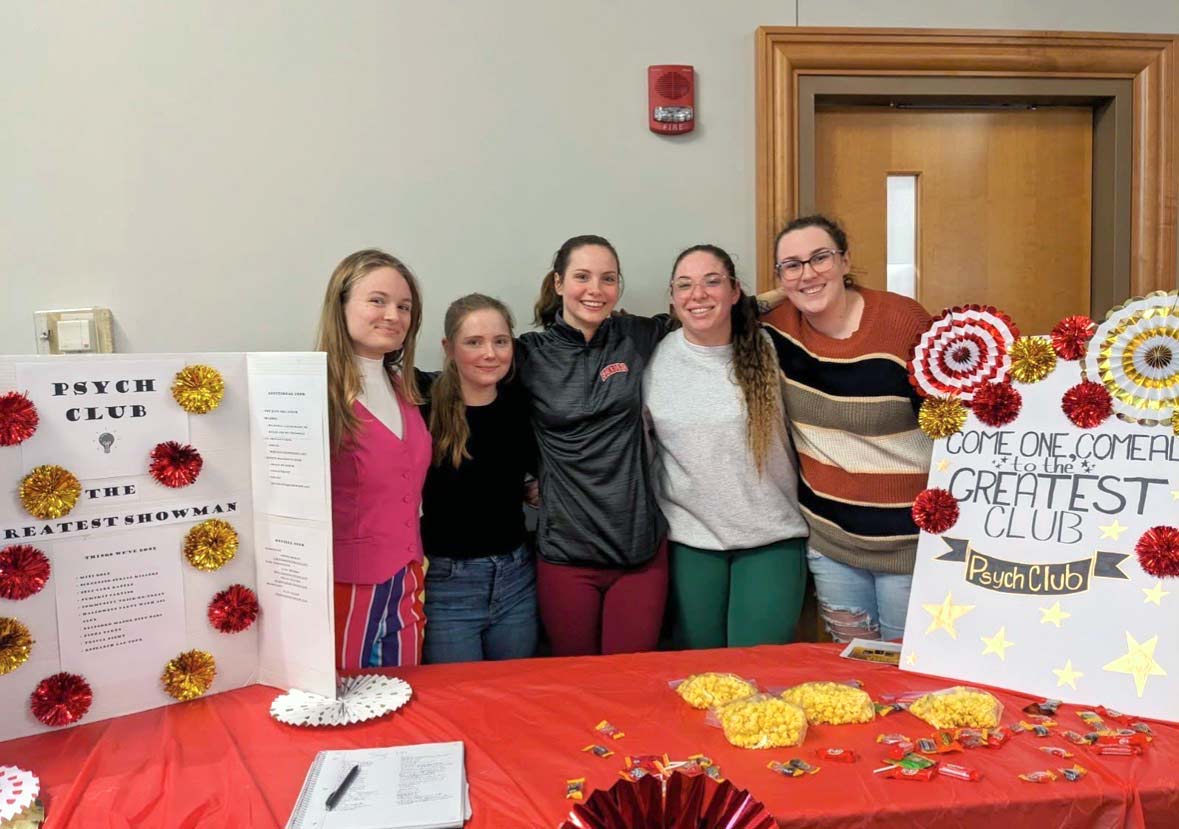
Beyond the lab, Amber leads as Psychology Club president and a Leadership Academy participant, channeling classroom learning into campus impact. She organized a Trauma-Informed Care panel—bringing together a police officer, Dr. Dixon, and a licensed social worker—to elevate evidence-based conversation around healing. The combination of undergraduate research, peer leadership, and community engagement has sharpened both her voice and her vision. As Psychology Club president, she’s built peer‑to‑peer support into the culture—think study nights, mentoring for first‑years, and quick debriefs after tough exams that normalize help‑seeking. These experiences crystallized her next step: graduate‑level training where neuroscience and care meet—whether in behavioral research or trauma‑informed clinical work.
Amber’s perspective has changed: she no longer sees behavior as something to judge but as something to understand. “Critical thinking matters,” she says. “We need that middle ground between gullible and skeptical.” In an era of viral claims and AI-generated realism, she’s learned to interrogate sources, seek replicable results, and keep humans—not headlines—at the center.
Amber came for an answer and found a vocation: use science to illuminate suffering and shape solutions. That path—equal parts discovery and service—thrives where labs, mentors, and student leadership intersect. At PennWest, that mix doesn’t just answer questions—it helps students learn how to ask better ones.