Branden Gmutza
Building What Comes Next
Branden Gmutza is turning curiosity into career-ready skill through Mechatronic Engineering
Technology and Electrical Engineering Technology, where solving real problems is part
of everyday learning.
Branden Gmutza
Building What Comes Next
Branden Gmutza is turning curiosity into career-ready skill through Mechatronic Engineering Technology and Electrical Engineering Technology, where solving real problems is part of everyday learning.
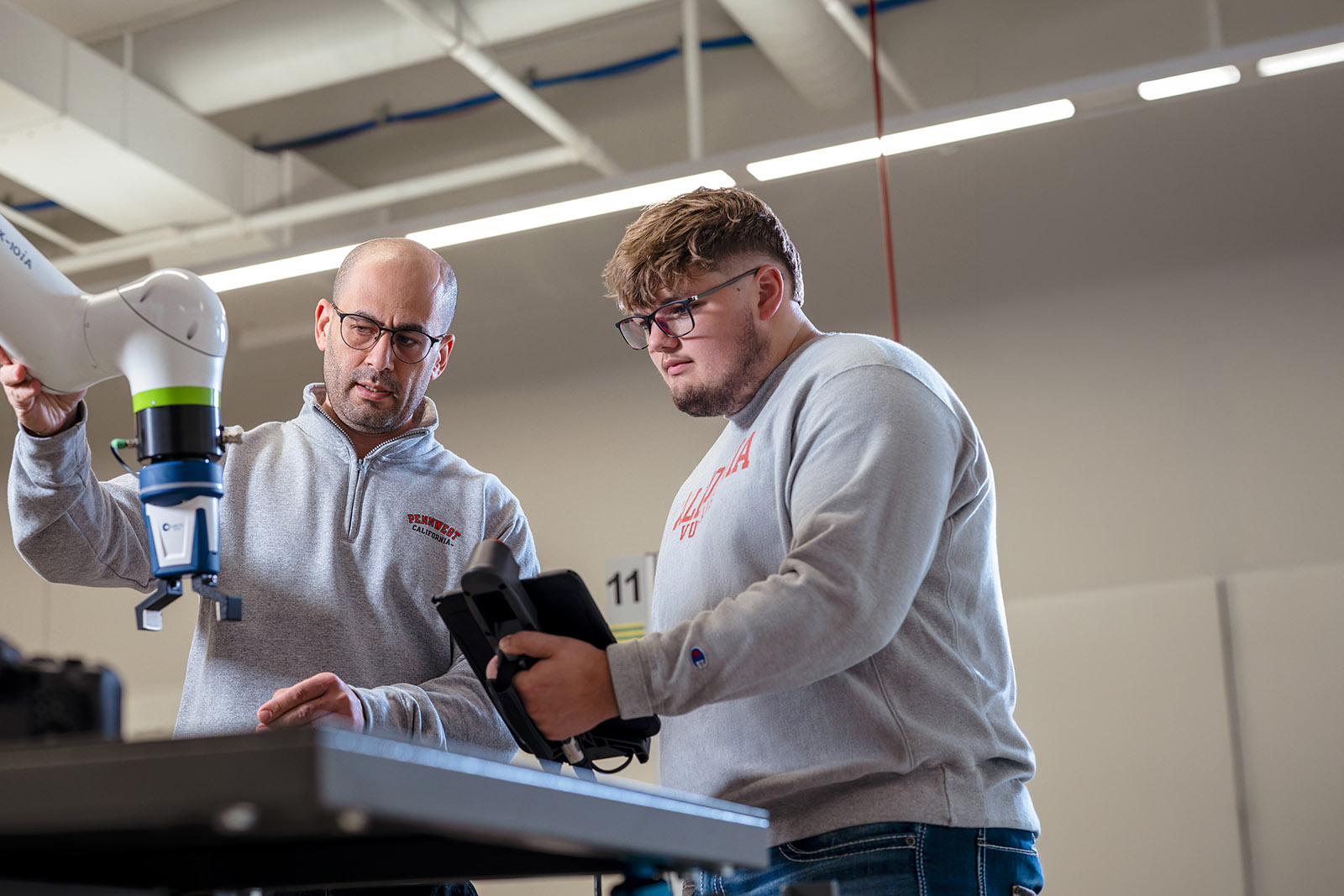
“What’s great about a lot of the projects that we do here is that they’re set up a lot like what you’ll see in the real world.”
Some students learn best by reading about how things work. Branden Gmutza would rather build them.
In a lab filled with whiteboards, wiring and senior project notes, Branden is doing the kind of work that turns ideas into something real. A dual major in Mechatronic Engineering Technology and Electrical Engineering Technology at PennWest California, he chose mechatronics first, then decided to add a second major after arriving on campus with enough college credits to shorten his timeline. Instead of finishing early, he saw an opportunity to go deeper.
That decision fits the way Branden thinks. He describes mechatronics in simple, practical terms: “It’s basically the bridge between the core four. It’s a little bit of mechanical, a little bit of electrical, a little bit of robotics and a little bit of computer science. So, you’re kind of like a jack of all trades.”
For Branden, that broad foundation helped him discover the area he enjoys most.
“I found that I’m really interested in the electrical side of things,” he said.
PennWest gave him a chance to test that interest in real projects. One of the biggest was in his automatic controls class.
“It’s a really fun class because we get to build the elevator project,” Branden said. “You’re basically just given a problem statement and then you have the semester to finish it.”
He and his team developed the coding, mechanical design, electrical design, wiring and construction from the ground up. It was one of those experiences that showed him engineering is is more than getting the right answer on paper; it is about figuring out what went wrong when the first try isn’t successful.
Describing the integration phase, Branden put it simply: “It’s a nightmare.”
On one project, his team discovered a missing ground on an HMI – or human-machine interface – which allows users to interact with and control a system.
“There was no ground on our HMI, and that took us a little bit of time to figure out that we had to put our own ground on,” he said.
That kind of challenge is exactly why the work matters to him. At PennWest, Branden is not only learning concepts. He is learning how to respond to deadlines, troubleshoot problems and keep going when the plan needs to change. As president of the Engineering Technology Club and a student working through advanced lab projects, he is building the kind of confidence that comes from doing.
He is still deciding whether his next step will be graduate school or industry, but Branden already knows what will carry forward.
“No matter where I end up working, I will be given a problem statement. I will be told, ‘Please solve this within this amount of time,’ and I will have to do that by that deadline,” he said.
That mindset, shaped through project-based learning and collaboration at PennWest, is preparing him to step into environments where the work is hands on, the challenges are real, and the learning moves beyond the textbook.
Listen to the full story on the Power of PennWest Podcast