Elyssa Baczynski
Making Room for the Stories History Leaves Out
A PennWest student explores women’s history, museum representation and what it means
to tell a fuller American story.
Elyssa Baczynski
Making Room for the Stories History Leaves Out
A PennWest student explores women’s history, museum representation and what it means to tell a fuller American story.
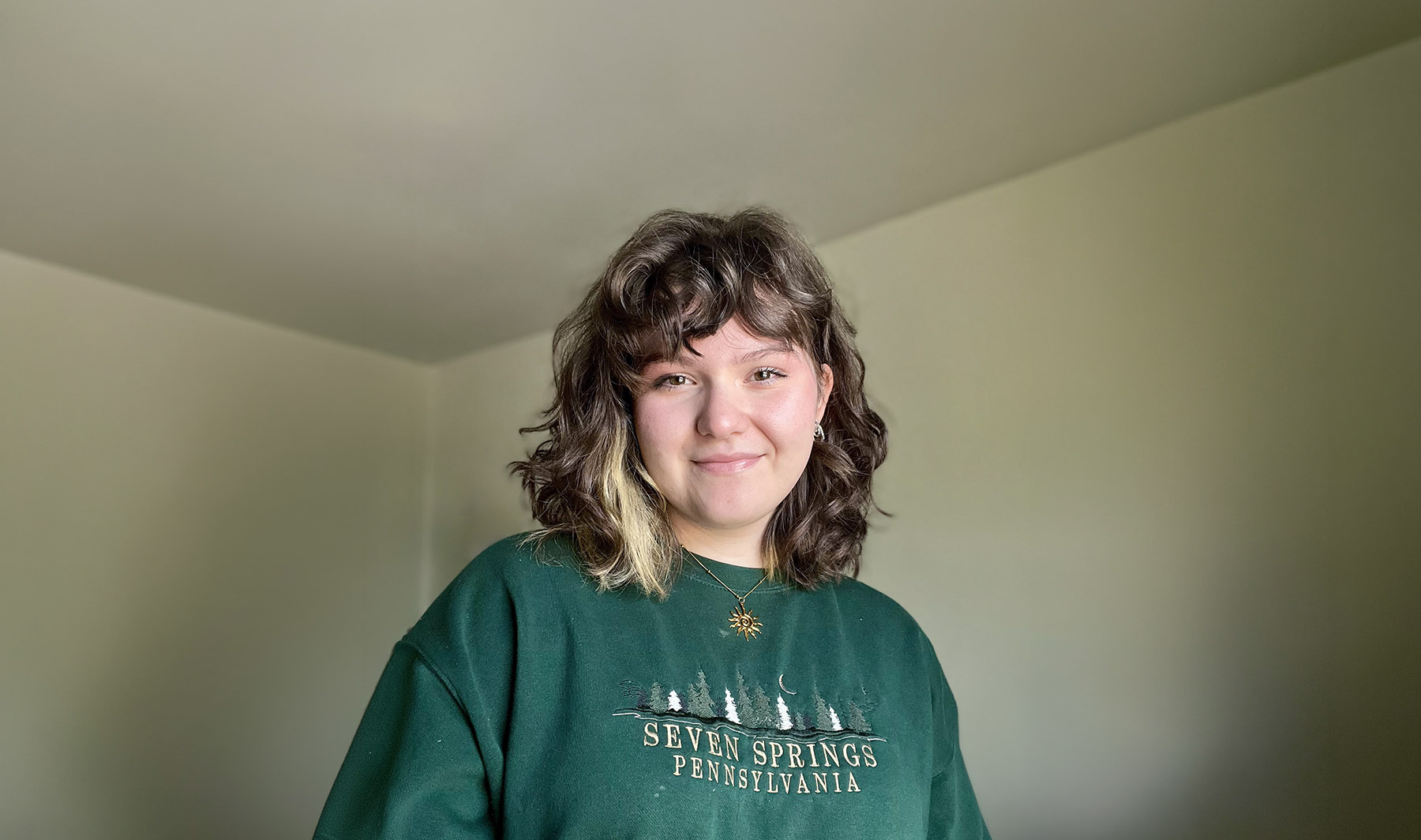
“I just want to see a little bit more working together.”
Elyssa Baczynski has always been drawn to the story behind the present.
A PennWest student from New Kensington, Pennsylvania, Baczynski is a history major with a minor in Museum & Galleries Studies. Her academic interests focus on U.S. history and women’s history, but her curiosity began long before college.
“I’ve always knew I was going to go to college when I was younger,” Baczynski said. “I’m a first generation, but my I was always stuck on what I wanted to go to school for. It was always between either art or history.”
By high school, history had become the clear choice.
“I think once I reached high school, I decided on history, because I had this really, I had this huge fascination with what made today, I guess I would have put it, there’s a fascination with the history of everything,” she said. “What is the story of today?”
That question continues to shape how Baczynski thinks about the American experience. To her, history is not only about dates or events. It is about understanding how people, places and decisions shape the world we live in now.
“US history is really important to me, because I love what America stands for,” she said. “It is meant to be a land where anybody can be American, you can practice your own religion or your own, you can have your own identity.”
Her interest in museums grew from the same place. Baczynski realized that her love of art and history did not have to be separate. Museums offered a way to bring both together.
“I realized that I can technically mix both of those together if I do like, you know, art history, and found an interest in museums,” she said.
For Baczynski, museums are more than buildings filled with artifacts. They are places where people encounter identity, memory and meaning. They help visitors understand what a place values and what stories it chooses to preserve.
“museums are very culturally important, especially in a state or a country, because if someone were to come from somewhere else, and they went to like a Pennsylvania history museum, they’re learning about one place they didn’t know before,” she said.
Although she is from Pennsylvania now, Baczynski was not born here. She moved from Florida when she was young, and one of her early museum memories was visiting the Carnegie Museum in Pittsburgh on a school field trip.
“I remember walking through these exhibits, and I’m like, wow, this, the state is so rich in just what happened here, and what formed the country,” she said. “And I was just, you have what was left from before preserved. It’s giving what Pennsylvania is today, and it’s telling you how it was made.”
As the United States prepares to mark 250 years, Baczynski has been thinking about what America preserves — and what it still needs to recognize more fully.
In an ENG 1200 research paper, she combined her interests in museums, women’s history and the semiquincentennial of the United States. The assignment asked students to write a research paper connected to their major. Baczynski first considered a broad history topic, but then found a more specific focus.
“I took women’s history museums, because I don’t necessarily, I noticed that there’s not one in Pittsburgh, at least where I’m closer to Pittsburgh,” she said. “And I noticed that there is not a specific museum representing women of history, American history.”
Her research focused on the need for a Smithsonian American Women’s History Museum and the importance of representing women as central to the nation’s story, not as a side note.
“I kind of wrote about how the fact that they’re not here yet, and we’re celebrating 250 years, seems kind of anti patriotic, or just isn’t really patriotic, because we’re celebrating such a monumental moment, but you’re forgetting so many people in history,” Baczynski said.
While her paper focused mainly on women’s history, she sees the issue as part of a larger question about representation.
“And again, I focused mainly on the women’s history part of it,” she said. “But this also goes for other people in it.”
For Baczynski, telling a fuller American story is part of honoring the country, not criticizing it. The American experience, she believes, should include the people whose contributions have too often been minimized or separated into small exhibits instead of being treated as central to the nation’s development.
“You go to a museum, US History Museum,” she said. “Yes, there’s women featured in it. But it’s never specific. You can’t really find anywhere that’s dedicated specifically towards the women of American history.”
That commitment to inclusion also shows up in Baczynski’s campus involvement. She serves as a CORE Student Ambassador, Clarion History Club president, Vice President of Membership Development and Vice President of Equity and Belonging for Delta Phi Epsilon, and treasurer and secretary for Tau Beta Sigma Honorary Band Sorority.
Her leadership reflects the same belief that drives her research: communities are stronger when more people are seen, included and understood.
As she looks toward the future, Baczynski hopes the country continues moving toward connection.
“One could only hope that definitely everybody continues to go off the idea that everybody is equal,” she said.
She sees both optimism and pessimism in the world around her, especially through social media. But her hope for the future is simple.
“I just want to see a little bit more working together,” she said. “That’s what I can hope for. More understanding.”
For Baczynski, America’s 250th anniversary is not only about looking back. It is a chance to ask whose stories have been preserved, whose stories still need more space and how the next generation can help build a more complete understanding of the American experience.
“I definitely hope that it continues on and that there’s more connection, community, and just humanity upon everyone,” she said.