California, Clarion, Edinboro, Global Online
PennWest faculty lead national roundtable honoring influential criminologist Stanton Samenow
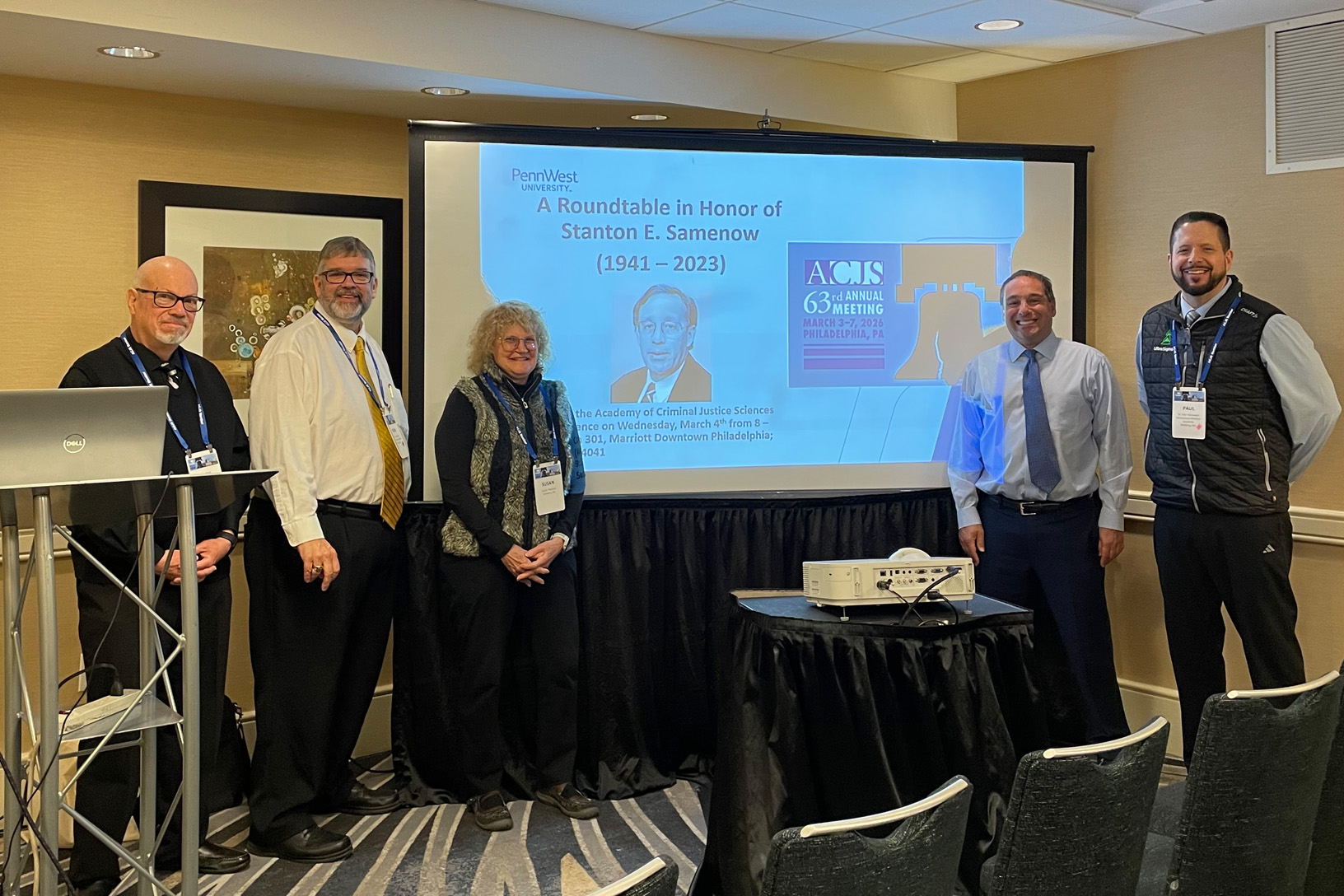
Faculty from PennWest University helped lead a national conversation on the enduring impact of pioneering criminologist and psychologist Stanton E. Samenow (1941–2023) during a roundtable discussion at the annual conference of the Academy of Criminal Justice Sciences in Philadelphia.
The March 4 event brought together scholars and practitioners to honor Samenow’s legacy and discuss how his groundbreaking work on criminal cognition continues to influence criminology, psychology and correctional practice.
A clinical psychologist, Samenow spent decades researching the patterns of thinking that contribute to criminal behavior. His work focused on identifying “thinking errors” and faulty cognition among offenders, helping shape approaches used by correctional professionals working to change criminal behavior.
The roundtable was moderated by Kevin Courtright, Ph.D., a criminal justice faculty member at PennWest University. Panelists included Paul Klenowski, Ph.D., a criminal justice faculty member at PennWest; Susan Packard, Ph.D. ’75, a psychologist and therapist in private practice and professor emeritus of PennWest Edinboro; Gary Cornelius ’74, a retired lieutenant from the Fairfax County, Virginia, Office of the Sheriff and a PennWest Edinboro graduate; and psychiatrist Charles Samenow, M.D., one of Stanton Samenow’s sons.
Together, the panel examined why Samenow’s work resonated so strongly with professionals working in corrections and criminal justice, particularly practitioners who later transition into academic roles. His research emphasized that while many factors influence criminal behavior, individuals ultimately make choices shaped by faulty thinking patterns — an idea that continues to inform correctional practice and cognitive-based interventions today.
Samenow authored numerous books and articles throughout his career, including the widely read “Inside the Criminal Mind,” which was revised and updated in 2022. His work has influenced generations of practitioners and scholars and contributed to the development of modern approaches such as cognitive behavioral therapy and other cognitive-based rehabilitation strategies used in correctional settings.
Courtright noted that the roundtable was organized to celebrate Samenow’s decades-long influence on the field and to encourage continued scholarly discussion of his ideas.
Participants reflected on how his research helped shape contemporary theoretical developments in criminology and inspired practitioners seeking practical approaches to understanding offender behavior.
The panel also highlighted the important role PennWest faculty continue to play in national academic conversations on criminal justice and corrections.
The event was made possible in part through support from the PennWest Center for Faculty Excellence.
Pictured: Gary Cornelius; Kevin Courtright, Ph.D.; Susan Packard, Ph.D.; Charles Samenow, M.D.; and Paul Klenowski, Ph.D.