California, Clarion, Edinboro, Global Online
Professors write finance textbook built for real life
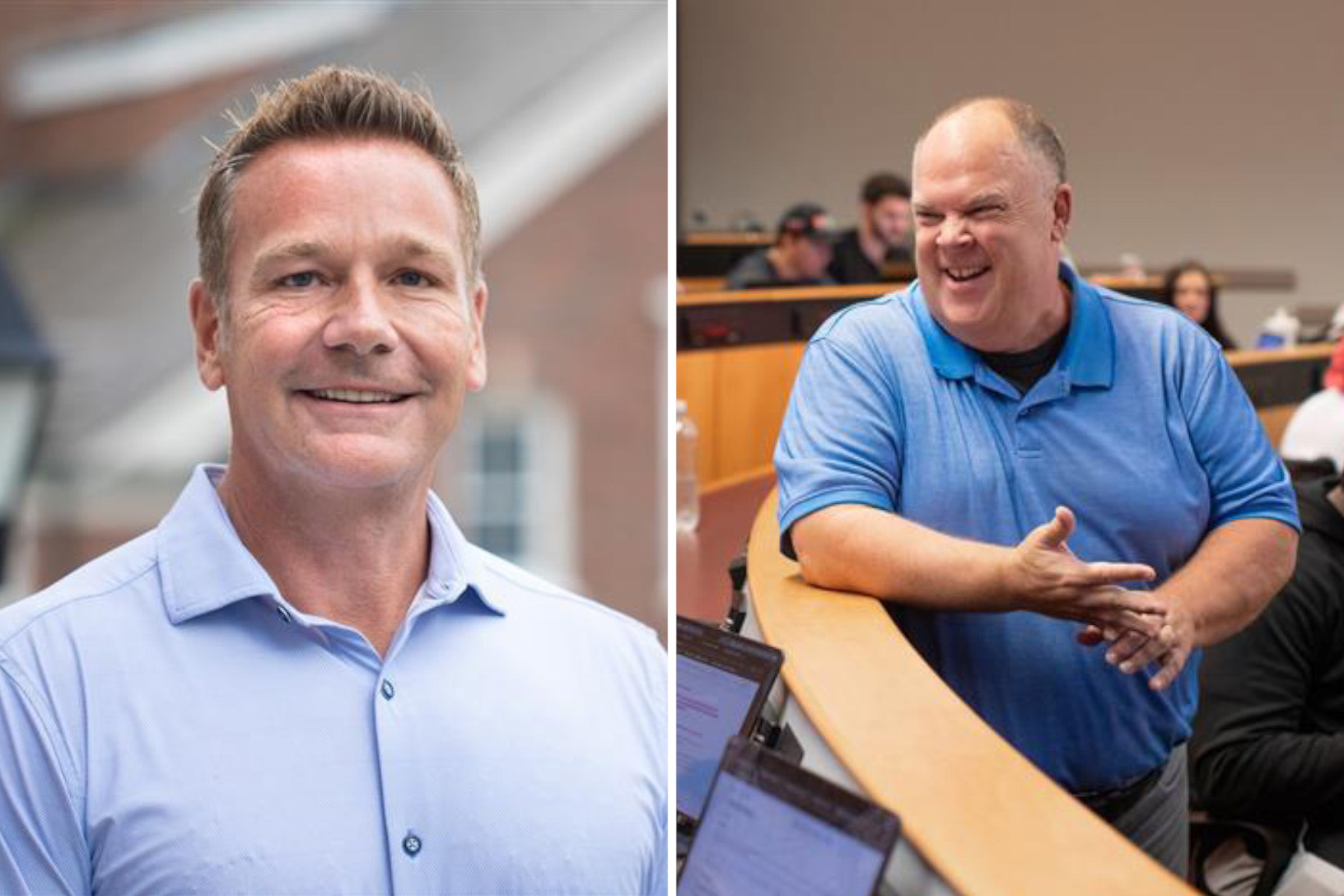
In classrooms across PennWest, Chad Smith and Christian Ola have watched students arrive motivated, capable and ready to take the next step — even as many are beginning to navigate how everyday financial decisions shape the lives they are building.
Over time, those classroom conversations revealed a common thread. Students were not lacking ambition or curiosity, but many were encountering foundational financial questions for the first time, often alongside other major life decisions.
The realization prompted an unexpected collaboration -- Personal Finance, a textbook designed specifically for the classroom and rooted in real-world application. The project highlights the expertise of Smith, a professor of management at PennWest, and Ola, an associate professor of finance, both of whom spent years working in industry before entering academia.
“It is not that students are uninterested or unmotivated,” Smith said. “Many of them have simply never been shown how all of these pieces fit together.”
For Ola, whose professional background includes mortgage banking and lending, the pattern was familiar — not just among students, but across age groups and income levels.
“People are making big financial decisions without a framework,” Ola said. “That is where education can make an immediate difference.”
Built for how life actually works
Rather than focusing narrowly on advanced investing or abstract financial theory, Personal Finance takes a deliberately broad approach. The book covers topics students are likely to encounter early and often — budgeting, consumer banking, credit, debt, taxes, insurance, investing, retirement planning, estate planning, consumer rights and responsibilities, and emerging financial technologies.
The structure mirrors the way financial decisions tend to unfold in real life.
“We asked ourselves why we wouldn’t lay the chapters out the way life progresses,” Ola said. “You start with understanding a budget. Then you need a bank account. Then credit matters. Then you start saving, investing and planning for the future.”
Each chapter begins with a scenario that places students in a realistic situation, encouraging them to apply financial concepts to decisions they may already be making.
“It is intentionally practical,” Smith said. “There is nothing in this book that students will not encounter in real life.”
Ola described the philosophy as “blue-collar financial literacy” — not because the material is simplistic, but because it is grounded in common sense and everyday experience.
“Finance does not have to be scary,” Ola said. “You do not need to be a rocket scientist to do this, to live a healthy, happy life.”
A book for every major
While both authors come from business-related disciplines, they see the book’s impact extending far beyond finance or management classrooms.
“We would love to see it used in finance programs,” Smith said. “But we believe it reaches far outside of that. This is for introductory courses. This is for general education.”
To support that broader audience, the book includes extensive instructor resources, allowing faculty outside the business disciplines to teach it with confidence.
“We designed this so you do not have to be from the business department to teach it,” Smith said. “We provide the resources behind it, because instructors may not have been taught this material themselves.”
Ola framed that accessibility as part of a university’s broader mission.
“These are life skills,” he said. “A chemistry major, a sociology major, a nurse, a public relations student — they all deserve to graduate understanding how to manage their finances and contribute productively to their communities.”
Cost vs. Value
One of the most deliberate choices the authors made was addressing the cost of higher education head-on. Smith and Ola believe personal finance education must include honest discussions about debt, return on investment and long-term decision-making.
“I have had students tell me they are here because their parents want them here,” Smith said. “Sometimes the most responsible conversation is acknowledging that college may not be the right path at that moment.”
Smith said those conversations are not about discouraging education but about encouraging clarity.
“I ask students to think about their career goals, expected salary, and current debt,” he said. “Those things matter.”
Ola shared a guiding principle he often discusses with students.
“It makes no sense to graduate with more student loan debt than your first year’s salary,” he said. “That math simply does not work.”
That same mindset has led both professors to encourage efficiency when possible, including graduating early.
“I have students finishing in seven semesters instead of eight,” Ola said. “Why take on additional debt if you do not have to?”
For Smith, those conversations are rooted in care — not criticism.
“It bothers me when a student graduates and does not know if it was worth it,” he said. “They should leave knowing they are prepared and ready to succeed.”
A partnership shaped by PennWest
In another way, the book reflects PennWest’s own evolution. Smith, based at Clarion, and Ola, at California, met through cross-campus collaboration following the university’s integration, a connection Ola said may never have happened otherwise.
“It was one of those unintended blessings of the merger,” Ola said. “I never would have had the opportunity to meet Chad.”
What began as a professional connection quickly became a collaborative partnership, built on shared values and mutual accountability.
“We pushed each other,” Smith said. “That made the project stronger.”
Ola agreed.
“Accountability partners is the perfect description,” he said.
The book includes a foreword by PennWest President Jon Anderson, whose background in business education and engagement with students made him a natural fit.
“To watch him interact with students was exactly what we hoped it would be,” Ola said. “He practices what he teaches.”
When the authors asked Anderson to contribute the foreword, the response was immediate.
“It took about 12 seconds,” Ola said.
From idea to publication
Neither Smith nor Ola had written a textbook before, but they credit the publisher with guiding the process from draft chapters to a polished final product.
“We told them upfront what we did not know,” Ola said. “They told us to focus on writing something useful for students and instructors.”
Seeing the finished book for the first time was a surprise.
“We realized they have an entire team behind this,” Ola said. “It was like seeing something move from notes on paper to a fully produced work.”
Looking ahead
As the book enters the review and adoption process, Smith and Ola remain focused on the outcome they care about most: confidence.
“If a student finishes this course and says, ‘I can do this,’ that is success,” Ola said. “That is the goal.”
Smith agreed.
“This is one area of life people truly can control,” he said. “We want students to leave knowing that — and knowing they are capable.”
For Smith and Ola, Personal Finance is less about mastering money and more about empowering students to move forward with intention — one informed decision at a time.