Azadeh Block
Freedom, Family and the American Experience
A PennWest professor reflects on immigration, identity, education and what it means
to expect more from the country she believes in.
Azadeh Block
Freedom, Family and the American Experience
A PennWest professor reflects on immigration, identity, education and what it means to expect more from the country she believes in.
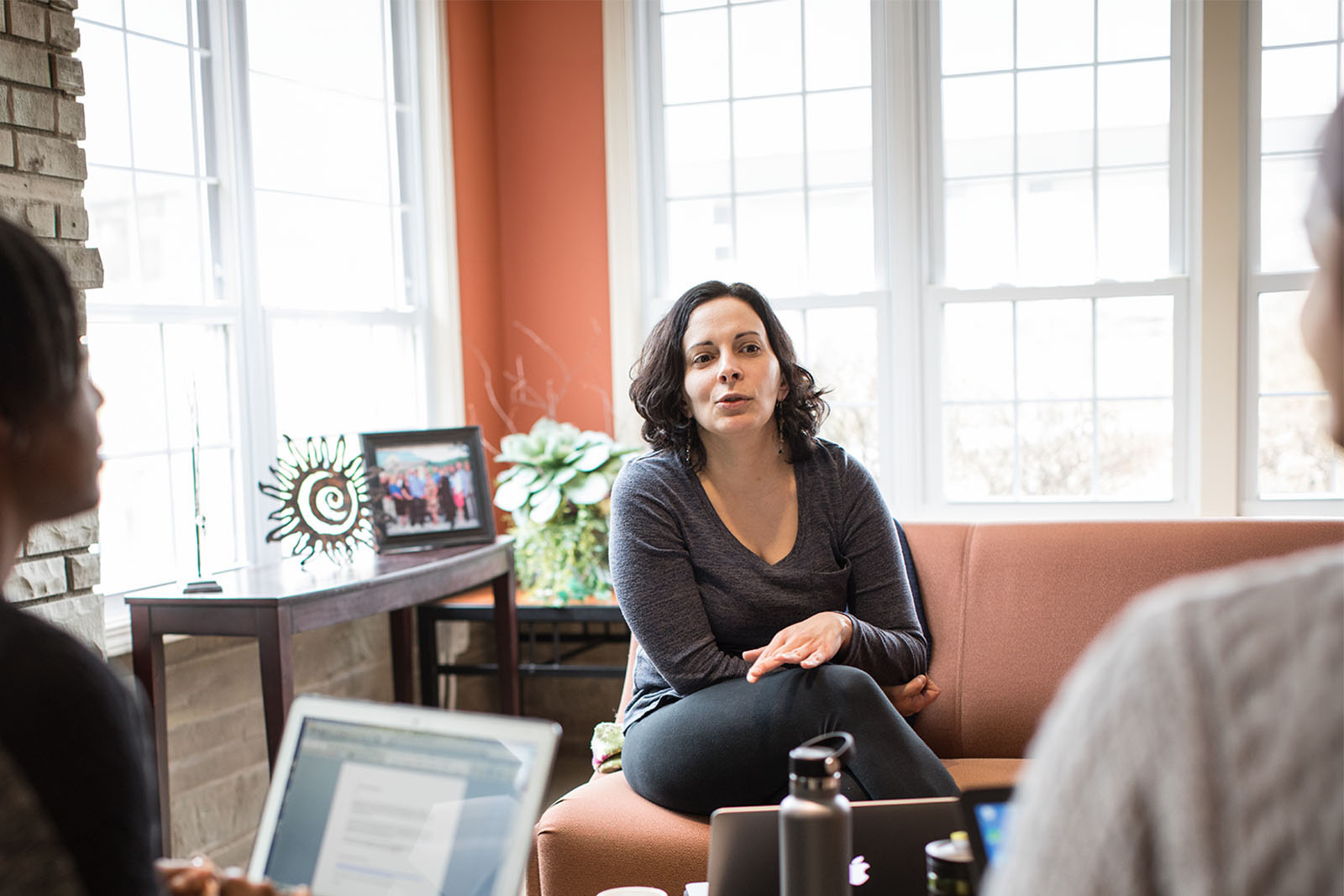
“There's still a promise here that you could achieve anything and people still have that vision of America.”
For Azadeh “Azi” Block, the American experience is not one story. It is many stories layered together.
On her mother’s side, Block can trace her family history to the Mayflower and to Western Pennsylvania through an ancestor who served in the Revolutionary War. On her father’s side, her family story includes immigration from Iran, higher education in the United States and a return to Western Pennsylvania during a time of upheaval.
“I'm aware of my family history dating back to the Mayflower in the United States,” Block said. “We're descended from Stephen Hopkins, who's a pretty famous Mayflower guy.”
Her mother’s family later settled in Western Pennsylvania after Roger Geer, an ancestor who served in the Revolutionary War, returned from military service. That history gave Block one connection to the country’s founding story.
“On my mother's side of the family, I'm a daughter of the American Revolution,” Block said. “But my father emigrated here in 1965 from Iran to go to school.”
Her parents met at Boston University. Her mother was pursuing a master’s degree in special education, while her father was continuing his studies as an international student. They planned to raise their family in Iran, where Block’s mother taught at the American school.
“My parents intended to raise us in the Middle East and raise us in Iran,” Block said. “But a lot of things changed that, including the revolution.”
When the Iranian Revolution happened in 1979, Block’s mother was pregnant with her.
“But when the revolution happened in 1979, as she was pregnant with me, they had to flee and come back to Western Pennsylvania,” Block said.
Block was born in New Castle, Pennsylvania, where her grandfather worked as a psychiatrist. Growing up, she came to understand that family history is often more complex than people assume.
She remembers an early school assignment about family history. She wrote that her family came over on the Mayflower. Her teacher gave her a zero.
“And my mom called and she said, Why did you fail her?” Block said. “And she was like, well, she didn't her family didn't come over the Mayflower. And my mom was like, Oh, they most definitely did.”
For Block, that experience became part of a larger lesson about identity, assumptions and the importance of cultural humility.
“I think it just that's probably the origins of my like, social work stuff,” Block said. “And all my cultural humility stuff is that sort of people make assumptions about you.”
Today, as a PennWest professor, Block brings that perspective into her teaching. She helps students understand how to work with people in moments of challenge without reducing them to assumptions about background, appearance, religion or circumstance.
“I teach students how to rise to a challenge, but also how to like look at someone and not make presumptions about them based on where they live, what color their skin is, what religion they are,” she said.
As the United States marks 250 years, Block sees the anniversary as a chance to reflect on freedom, immigration, citizenship and the continuing work of building a better country.
“Our thing is freedom,” she said. “Statue of Liberty, all these like symbols of what it means to be a free society.”
That idea is personal for Block. Her parents returned to the United States after the revolution in Iran because they knew their freedoms would change if they stayed.
“I think my own parents’ story of returning here after the revolution in Iran speaks to freedom that they knew they would no longer have living in a religious state, which is how this country was founded,” she said. “It was people seeking religious freedom.”
But Block also believes celebrating America requires honesty. The promise of America remains powerful, she said, but people’s experiences of that promise vary widely.
“There’s still a promise here that you could achieve anything and people still have that vision of America,” she said. “And I think that's definitely something to celebrate.”
At the same time, she believes citizens have a responsibility to expect more.
“And I guess that's how I sometimes feel about the United States,” Block said. “I expect more out of us. And you have to be an involved citizen if you're going to expect more out of your country.”
“I want to be generative, but I want to hand it off to the next generation to really take it and keep making the world a better place.”