California, Clarion, Edinboro, Global Online
PennWest professor revisits media writing for a changing profession

Dr. Andrew Lingwall wants his students to give themselves a chance to become good writers before deciding a machine can do it better.
It is a concern he returned to while revising “The Basics of Media Writing: A Strategic Approach.” Students preparing for media careers need to understand artificial intelligence. They also need practice asking questions, checking information and explaining what they have learned.
“It’s a means, it’s a tool, but it’s not the end in itself,” said Lingwall, a communication and media professor at PennWest University’s Clarion campus.
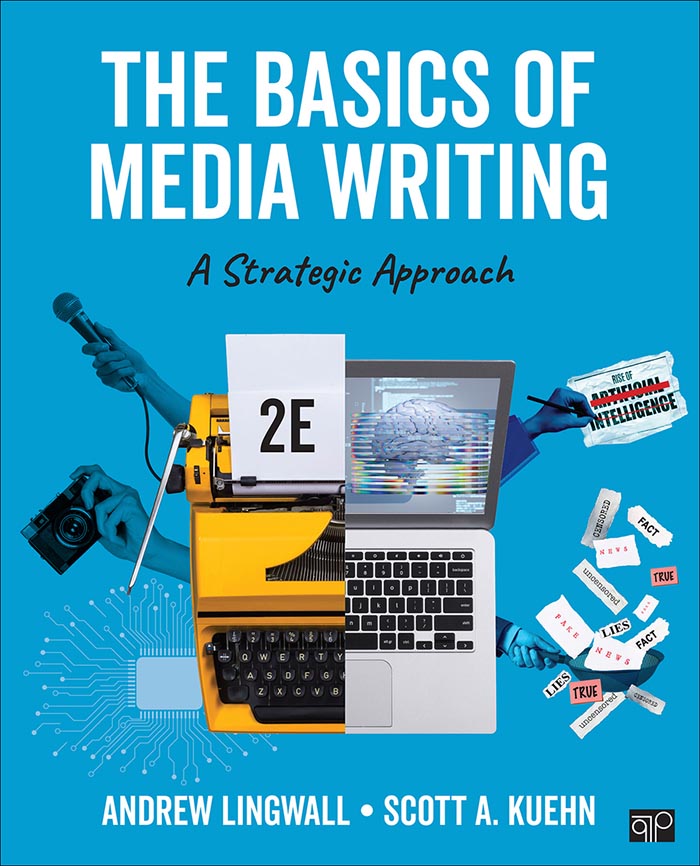
Published this year by CQ Press and co-authored with Scott A. Kuehn, the second edition covers reporting and interviewing, copyediting, media law and ethics, and writing for websites, social media, public relations, advertising and business.
Nearly a decade after the original, Lingwall had plenty to reconsider.
“I did a lot more than just a light rewrite,” he said.
The broadcasting chapter became “Video and Audio Writing,” with a section on podcasting. New features address AI, misinformation and disinformation. Exercises were reworked to reflect assignments students might encounter in their careers.
Lingwall interviewed roughly 30 media professionals, including The Atlantic’s Tom Nichols, PBS NewsHour’s Liz Landers and younger reporters establishing themselves in the field. Public relations practitioners shared advice about their work.
Those conversations are already shaping classroom assignments. In his online media writing class, which includes students from California, Clarion and Edinboro, Lingwall asked students to read journalist David Drucker’s stories and examine his approach to reporting and interviewing.
The book also turns students’ attention to their own habits. Do their minds go blank when they begin an assignment? Is their first draft usually their last? A self-assessment helps identify areas for improvement, while the Professional Strategy Triangle asks them to consider the situation, audience and message before writing.
Lingwall wants students to develop enough confidence to make deliberate choices about using AI.
“Humans still have to do the essential writing tasks,” he said. “That’s what I tell the students.”
A former newspaper reporter and public relations professional, Lingwall also emphasizes learning from experienced colleagues and becoming comfortable approaching strangers, asking questions and taking notes.
“There’s still a lot of old school skills in the book,” he said.
Those lessons matter beyond media careers. Some students in his course plan to become nurses or elementary school teachers. He wants them to leave better able to evaluate sources, distinguish fact from fiction and communicate clearly.
Keeping the textbook current remains a challenge.
“Even the idea of trying to write a book on this topic is a real moving target,” Lingwall said.
But the professionals he interviewed reinforced the need for concise, precise writing in a crowded marketplace of ideas.
“We make the point in the book that writing is more important than ever.”