
Dr. Mark Lennon is turning his experience as a Fulbright U.S. Scholar in the Brazilian Amazon into free educational resources for students and researchers on two continents.
Lennon, a professor in PennWest University’s Department of Business, Economics and Communication, has developed English- and Portuguese-language textbooks on the use of artificial intelligence in graduate research, business, and research management. He is publishing the books as open-source materials for students at PennWest and universities in Brazil.
Designed for master’s and doctoral researchers as well as undergraduate students, the textbooks explain how generative AI works and how it can be used in academic research and professional practice. The materials grew from Lennon’s work in Belém, Brazil, and a series of articles he has shared on LinkedIn.
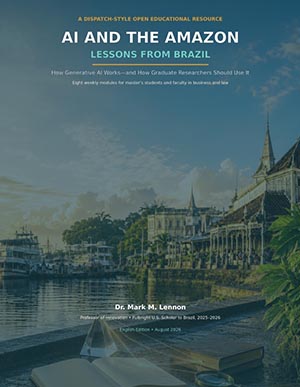
The books are being distributed at PennWest; Universidade da Amazônia, known as UNAMA, Lennon’s Fulbright host institution; and the Federal University of Pará, or UFPA. With assistance from UFPA and the Fulbright network, Lennon plans to share them with universities throughout Brazil.
Publishing the materials in both languages and making them available without charge helps remove barriers of language and cost while allowing Portuguese-speaking students and faculty to examine AI within their own academic and cultural contexts.
Lennon presented material from the textbooks during an August seminar at UNAMA titled “AI and the Amazon: Lessons from Brazil.” The program explored how generative AI works and how graduate researchers can apply it through eight learning modules focused on research and the foundations of management and law.
Lennon served in Brazil from May through September 2026. His work there focused on expanding AI literacy and access in the Amazon region.
“The Amazon is not peripheral to global innovation — it is the frontier,” Lennon said. “This Fulbright gives us the opportunity to build AI tools that reflect the languages, knowledge systems, and aspirations of communities that have too often been left out of the conversation.”