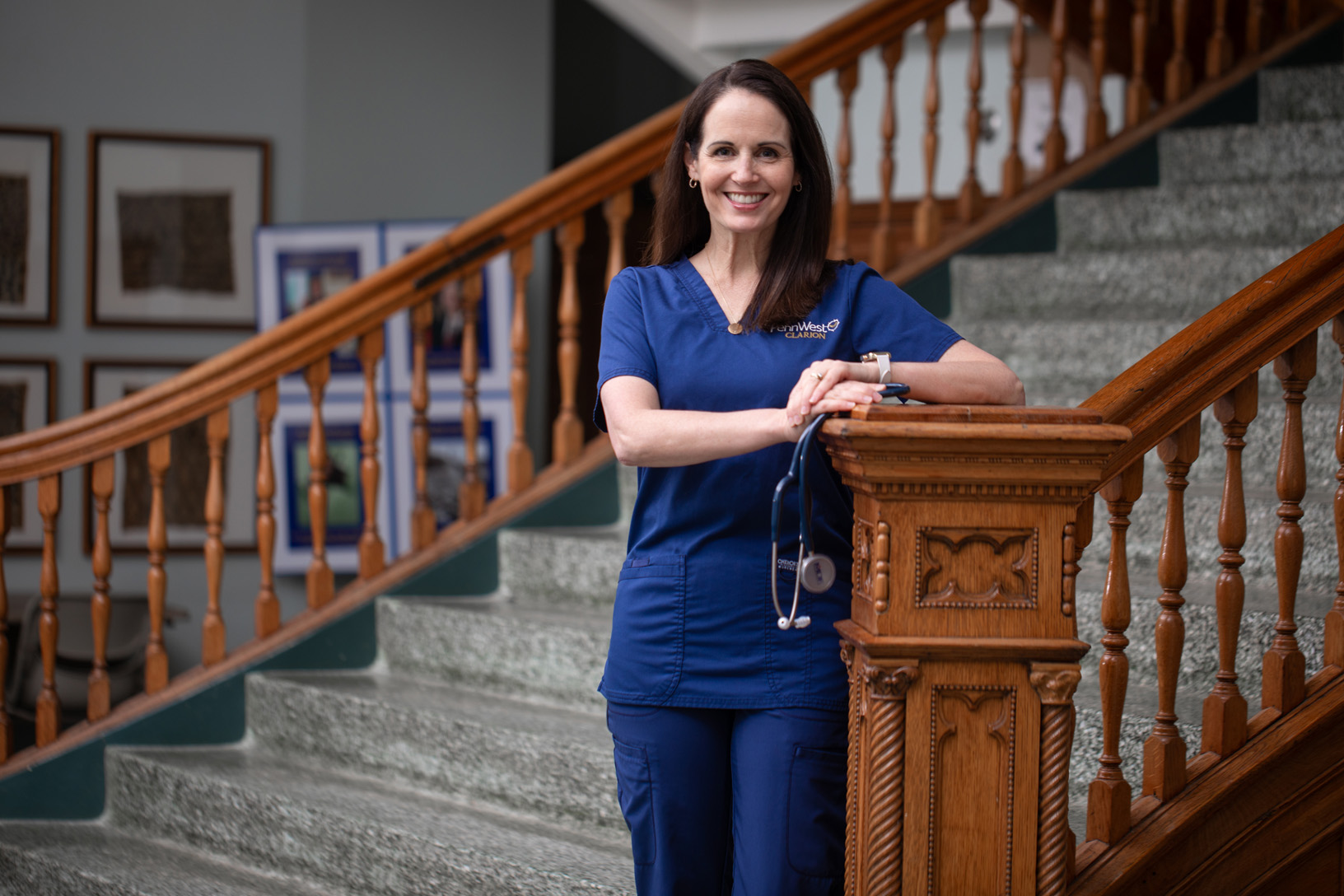
After raising seven children and watching most of them leave home to pursue their own paths, Kristy Anderson reached a point where she had both the time and the motivation to return to learning and give back through service. Nursing aligned with those goals, leading her to enroll in a nursing program for the second time.
“Thirty years ago, I was a nursing major,” she said.
Experiences as a teenager – first as a candy striper, then in a high school club that explored medical professions – had inspired her to pursue the profession. In college, “life happened,” and Anderson graduated with a bachelor’s degree in a different field.
Her career path shifted again when she, her husband Jon, and their son Bryce relocated to western Pennsylvania after Jon was selected as president of Pennsylvania Western University. Although she had already begun a nursing program in another state, Anderson remained committed to her goal.
“PennWest helped me transfer here seamlessly, providing help with credits that transferred and a clear path of what was needed to finish my degree,” she said.
Support continued in the classroom as Anderson balanced family responsibilities with the demands of a rigorous nursing program.
“The load of classes, homework, clinicals and studying required to succeed is enormous,” she said. “The nursing program is extremely rigorous, but having excellent professors who teach with clear objectives and who want their students to succeed has been so very helpful.”
She highlights simulation days as an important part of the learning experience. During these sessions, students are assigned patient scenarios and expected to respond as they would in a real clinical setting. Faculty use the exercises to build confidence and reinforce strong patient care practices.
“We are in the simulation lab with a mannequin, and the professors watch and listen from another room,” she said. “Afterwards, the professors talk through it with us, complimenting what was done well and offering suggestions of how we could improve.”
Weekly clinicals have also played a key role, giving Anderson the opportunity to apply classroom learning in a supportive hospital environment.
“Having hands on experience, interacting with patients and other healthcare workers, and practicing essential nursing skills in a hospital setting has been so helpful,” Anderson said. “Our professors are there with us at the hospital to answer questions and help us learn. We learn how to administer medications, and we do this with guidance from our professor.”
Those clinical experiences have included exposure to multiple areas of nursing.
“This semester we had a behavioral health unit and clinical, and it was impactful to apply in the clinical setting some therapeutic communication techniques that we had learned and to see the effect it had in real life,” she said.
Anderson is grateful for the exceptional instruction and learning experiences the ASN program has provided, and she’s developed a new level of appreciation for the hard work and dedication it takes to become a nurse.
“Many of my classmates have hectic lives with family and jobs, and many have a commute of up to an hour to get to class and clinicals. Many have endured hardships outside of school, but despite their personal hardships, they keep showing up,” she said. “My classmates are smart and hard working. They encourage each other.”
Anderson will graduate May 9 with an Associate of Science in Nursing. She is exploring job opportunities in the Clarion area, where her family’s primary home is located, and she feels prepared to take the next step.
“PennWest has provided a great educational experience with professors who care and offer help and support to understand the material and skills needed,” she said. “They have been awesome in every way.”